
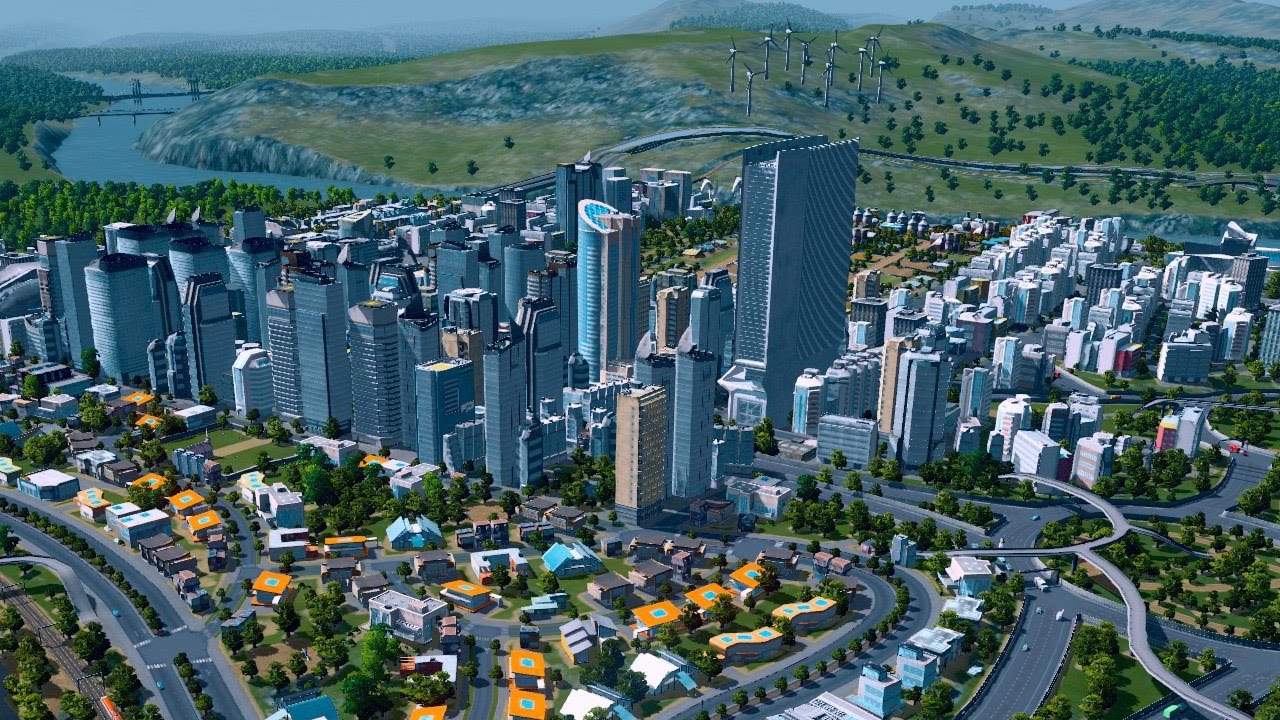
I like playing city building games, one of my favourites is City Skylines I, the sequel has been buggy and much less feature rich. Regardless, today I want to talk about how such games get the nature of money wrong.
In Cities Skylines, when you start a game, you start with ₡50,000 (the currency is called ‘Coin’), where does this money come from? No one knows. In real life, widely used money comes from two sources:
a. Central Bank via Government spending and Central Bank asset purchases.
b. Commercial Bank lending.
The latter ultimately relies on reserves at the Central Bank for clearing transactions, so really, no Commercial Bank can lend widely convertible money without the Central Bank.
Central Bank is an entity of the state, it was created by law. In India, it was the RBI Act 1934; in the U.S. it was the Federal Reserve Act 1913. For all the talk of Central Bank ‘independence’, it is fundamentally a state entity. It is the fiscal agent of the state.
In most video games, deep mechanics on banking isn’t necessary, since you are at the micro level. For example, in open-world games like Grand Theft Auto V, it isn’t relevant whether deep mechanics of financial plumbing. You ‘earn’ money, you spend it. Of course, in a video game, resources are unlimited because it’s all code anyway, you pretend you are resource constrained to make it more fun.
City building games however are supposed to model real world economies better. However, most of them fail at this because the developers likely have a backwards textbook view of how money works.
In Cities Skylines, you are dropped into an empty world with money. Why would anyone ever want this money? It is not made clear. In real economies, it is taxes that create base demand for currency.
One can assume for simplicity’s sake that ‘Coin’ is the currency of the entire Cities Skylines ‘world’ and that the Central Bank (for example, like the European Central Bank for the entire Eurozone) provides the city-state with currency.
So, you start with ₡50,000 the city account, you spend it to build roads, power plants, water pump etc. You can abstract this away by saying the state hired workers and imported from outside to build it. The issue is, once you built, people start pouring in from outside. But what are they enticed by? The only jobs available are at the power plant, water and sewage plant, construction and road maintenance. Now you have hundreds of people coming to the town with tens of jobs.
Yet for some reason, it is not only homes that show up but business and industry too! Where do these firms get money from? This is the biggest holes in the economy of such games. The private sector has unlimited credit at zero interest rates (from which bank? Who knows.) but the public sector is constrained and can only get limited loans from private banks. In real life, firms only invest, start a firm only if they think they can realize sufficient profits. But, in Cities Skylines, they seem to invest first even though unemployment is in double digits and no one has any wealth or income.
And once people do have jobs, they always buy fixed amount of goods no matter what. Of course, if you over-zone industry way too much and have no outside connections, you’ll get the classic overproduction issue and firms go bankrupt. This is realistic. But provided that you zone the ‘right’ amount of Industry there will never be a paucity of effective demand.
This of course is completely unrealistic, as even in a closed economy, there are multiple sources of leakages of demand including taxes, capitalists’ asset hoards and workers’ savings. Eventually, banks will refuse to lend and you get an economic slowdown even though there are ample resources available. But in the game, banks lend unlimited amounts at zero interest rate.
Even if it is assumed that capitalists don’t hoard at all and workers don’t save, the game nudges the player to run permanent fiscal surpluses. The city seems to go ‘bankrupt’ once the cash account goes to -₡100,000. So, the player must run a balanced budget long term at the least. And more typically, it will need to run surpluses to ‘invest’ and build roads and other infrastructure.
So, where are the people getting money to pay these taxes? No one knows. It means the non-Government sector is in a state of permanent deficit and accumulating more and more debt (to some entity). In real life, this is usually Commercial Banks, its why you have private debt bubbles like Dot-Com bubble, Housing bubble or recently, AI bubble.
But real-life bubbles always pop eventually. In the game, the non-Government sector borrows from some entity forever? Or is the non-Government sector the currency issuers and you the currency user? This is of course laughable since if you look at a bank note in real life you will see the name of the Central Bank, which is a state entity. Does each person (‘agent’) in the game have ability to issue widely used money? As if everyone is their own bank and have access? The non-Government sector can always pay taxes without doing any work whatsoever, money is worthless and has no meaning.
This is obviously not the case. Since people in the game work for currency, whether at industry, commercial or the public sector. And the non-Government sector has another entity it can get money from in unlimited amounts to satisfy the RCI Meter. RCI Meter is the metric in the game which shows ‘demand’ for various zones.
For example, if residential demand > residential supply and all the homes are occupied completely, then RCI Meter goes up. The issue is, RCI Meter shows notional demand i.e. what people want, not effective demand i.e. demand backed by ability to pay.
So, you can build all empty lots you want. In real life, no builder would want to build anything since they can’t find buyers with enough money to realize the profits the builder desires. In the game, the homes get built somehow, how the home is being sold for the profit (if it is even is sold for profit) to be realized is never shown in the game. Homes are built, people move in without paying for anything.
A mysterious ‘entity’ that is functioning as the stabilizer in the game. This is the entity that is true ‘deep state’ in the game, it is always willing to lend unconditionally, has monopoly on the issuance as if it were a sovereign and only lends just enough that all the demand is met.
It is a gameplay device to make the player feel as if the Government can run permanent surpluses while offloading everything to the private sector.
Now I want to talk about external sector. The game doesn’t model it very well at all. Firstly, in the game if you have over-zoned industry, as long as the logistics are sufficient, there will not be a paucity of demand. This means someone abroad is willing to import whatever the country is willing to export and providing it with Coins. The external sector always has enough Coin to purchase any excess output.
In real life however, the firms would run at below capacity simply because there isn’t enough effective demand anywhere, whether domestically or abroad. The firms also downsize and cause un/underemployment.
The trade in the game represents a neoliberal vision, where every country can dump all over-production abroad and grow by the way of exports, with infrastructure and logistics being the only bottleneck. Very supply-side mindset.
Similarly, the imports are also particularly odd. The aforementioned ‘entity’ is paying for it entirely. How so? The game doesn’t make it clear where the Coin to pay the imports are coming from. If you over-zone commercial buildings enough that local production < local demand, imports magically fill the gap, people always somehow have what they want and have enough money to pay for it even with double digit unemployment.
A trade deficit means that the rest of the world is willing to accumulate financial claims against you, in India’s case, U.S. private sector for example, wants to accumulate financial claims of Indian Rupee denominated assets.
Similarly, in the game, the external sector is willing to run accumulate financial claims against the city. Who is buying this? It can only be the ‘entity’. The ‘entity’ is external, it is willing to run financial account deficits so that your city gets to have a financial account surplus. This combined with the entity’s willingness to run deficits (real life commercial banks lend on profitability and demand, it doesn’t lend to ‘anyone’ because otherwise it will be insolvent, the entity is clearly having no solvency constraints).
Unemployment is another odd case. There is no demand constrained unemployment in the game. The only reason there is unemployment in the game is if you don’t zone enough offices/industry. As long as you watch the RCI meter and zone sufficiently, the ‘entity’ will make sure everyone who can be employed in the given zone is employed.
From all of this we can tell:
- The ‘entity’ has no solvency constraint
- The ‘entity’ does not lend/grant money to the City Government and is fine with it going bankrupt, only the private sector.
- The ‘entity’ ensures the output is sold and there is no overproduction crisis as long as logistics are sufficient.
- The demand bundle for each agent is fixed. If demand > supply i.e. output is insufficient, the ‘entity’ provides the supply needed to meet demand as long as logistics are sufficient.
- The ‘entity’ ensures that there is no unemployment so long as you zone enough.
In many ways, even if the game developers did not understand it, there are many parallels to reality. In India, state Governments are fiscally constrained. To get around this, they set up Commercial Banks and development banks to get money from the Central Bank which is a part of the Central Government, the sovereign currency issuer.
However, unfortunately, there is no magic entity ensuring output is sold and unemployment is reduced to frictional levels. This only exists in the game.
It is clear from all of this that the game developers used a very neoliberal economic framework while modeling the economy in the game. The neoliberals assume that that all three sectors i.e. Government sector, private sector and external sector can all run surpluses. This is false by identity.
If you modeled the economy accurately (i.e. there is no magic ‘entity’), you will find that if the City Government isn’t in deficit long term, there will be mass unemployment and an economic depression.
And the City will have a sovereign currency, because otherwise it will be financially constrained on top of being real resource constrained and therefore unable to provide full employment. With its sovereign currency, there can be a permanent Government deficit, which allows for growth and employment. The city account balance will always be in the negative. Commercial banks can also exist in this environment leveraging city currency.
To model external sector more accurately, you can have a floating exchange rate. This ensures the city isn’t getting external resources for ‘free’. The city might be able to get some ‘free’ resources if rest of the world is willing to accumulate its local currency denominated financial claims.
Obviously, all this is very complicated to model. So, it can be made in a way that there are no trade imbalances. The city is provided with a fixed amount of global reserve currency U.S ₡ at the start which it can use to import and build a base. It can then start its own Central Bank and issue its own currency once some people move in. Taxes can be imposed on utilities and goods which allows the city to spend the same to build what it wants, maintain full employment and grow.
Until then, city building games will not teach people how the economy works.
That’s all.