
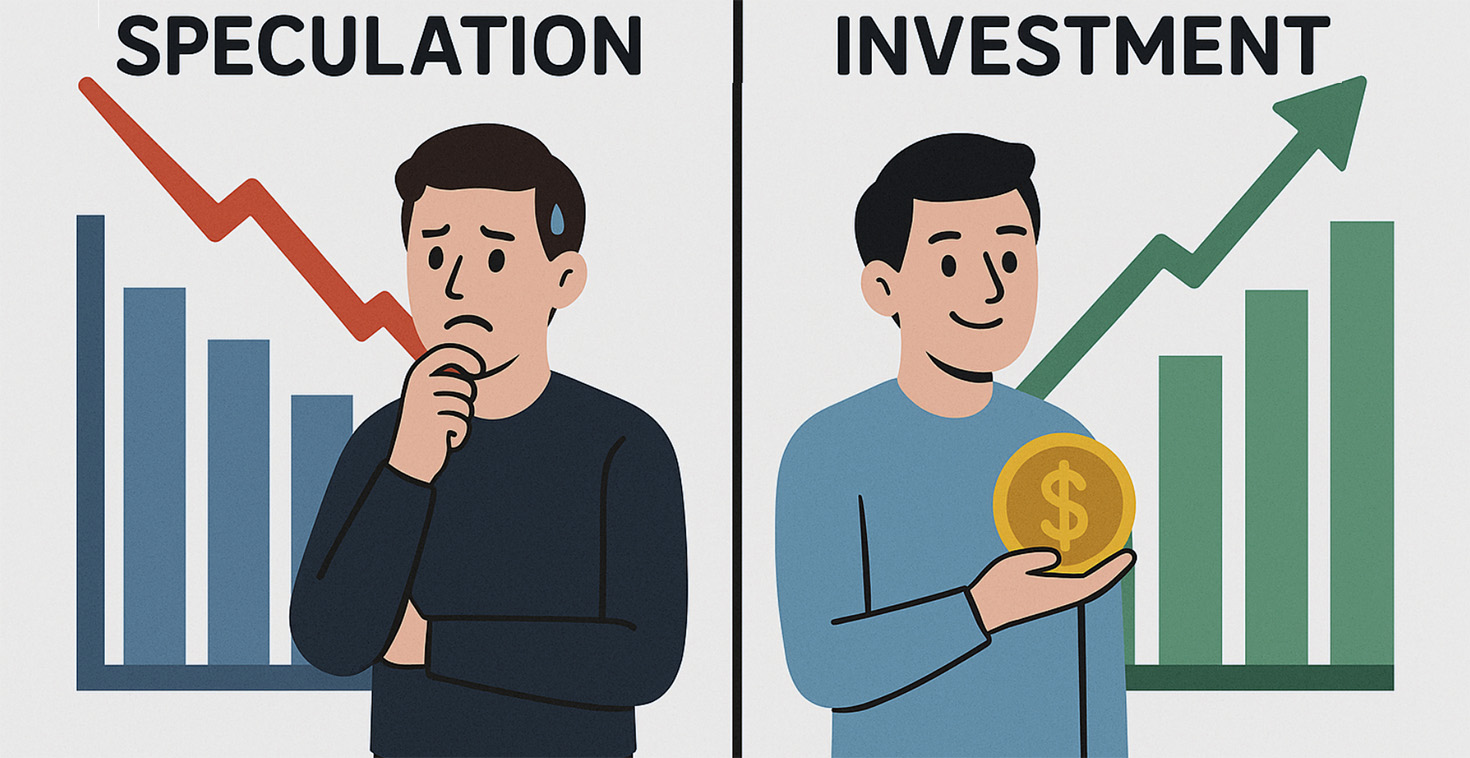
In today’s blog, I will explain how you are not helping in nation building by purchasing shares.
Rule 16 of the Central Civil Services (Conduct) Rules, 1964, which pertains to Indian Central Government workers, says:
_”No Government servant shall speculate in any stock, share, or other investment:
Provided that nothing in this sub-rule shall apply to occasional investments made through stockbrokers or other persons duly authorised and licensed or who have obtained a certificate of registration under the relevant law.”_
Speculating is typically defined as the frequent purchase or sale, or both, of shares, securities, or other investments. Investing is typically defined as the occasional, long-term, non-speculative purchase intended to hold for returns or savings.
I won’t go into the very blurry line between investing and speculating, even in the mainstream sense of the words. For example, many Government workers purchase shares under SIPs, which are frequent (but predictable) in nature.
The supposed purpose of this rule is to prevent insolvency for workers, as speculation can involve leverage, i.e. the use of borrowed funds for trading. It can also give the public the perception that Government workers are using insider information or misusing their position while chasing returns. Of course, insider trading is actually illegal for both public and private sector workers. Meanwhile, violation of most conduct rules, at worst, gets you dismissed from service.
The reason why I brought up this rule is because the reality is, you likely aren’t ‘investing’. If you define ‘investing’ as “commitment of money to receive more money later” then sure, but that also applies to speculation just as easily. However, many people think their purchase of shares is helping ‘build the country’, i.e. their ‘investments’ are being used to purchase fixed capital, pay wages, and cover other working expenses of companies. This is not true in most cases. In this blog, I will explain why.
Whenever you open a Demat account using a brokerage and purchase shares, you aren’t really helping with ‘nation-building’. There is only an asset swap: the person or entity selling the share receives cash and loses shares, while you gain shares and lose cash. The person isn’t the business. When you buy a share in the secondary market, say in Hindustan Unilever Ltd, HUL does not get any money from you; the person selling you the share gets the money. HUL neither gains nor loses money in this transaction.
So really, only the ownership of the asset is being swapped. Your money isn’t going to productive use; it’s very likely going to be hoarded by the person or entity selling the share. Keep in mind, purchases of financial assets, whether in primary or secondary markets, are not included in the GDP. The formula for GDP is Consumption + Investment + Government Spending + (Exports – Imports).
Your “investment”, i.e. the purchase of shares, is not included in GDP’s “Investment” component. Why? Because Investment is actually Gross Fixed Capital Formation (e.g. plant and machinery) + Change in inventories. So, only real investments in real goods and services are included in GDP; most financial transactions, including the purchase of securities, are not.
I will take a different definition of “investment” than textbooks: any transaction that results in a person or entity spending productively, such as purchasing machinery, hiring workers, and so on, rather than hoarding money as “savings”.
Under this definition, if you are engaging in the following transactions, you are not “investing”, and all are closer to “rent extraction” and “speculation”:
1. Purchase of securities, whether debt, equity, commodities, etc., in the secondary markets. This does not result in money going to productive enterprises, only ownership swaps. Most people who “invest” in equities in the secondary markets do so with the expectation that they will be able to sell them to someone else and realize capital gains. Unlike the mainstream view that people “invest” based on “fundamentals”, people really buy shares based on whether others buy the same share and push up the prices so they can realize gains. See the _Keynesian beauty contest_. This makes the line between “investing” and “speculating” blurry even under typical definitions.
2. Purchase of sovereign currency securities, whether in the primary or secondary markets. One might think that when the sovereign currency issuer, in the case of India the Central Government, issues Government Securities (G-Secs), they are “investing” in the country’s future by lending money to the Government. This is not true for the Central Government; all widely accepted Rupees originate at the Central Government (RBI + Finance Ministry) or at Commercial Banks (via lending, i.e. balance sheet expansion). The only reason why the Central Government sells securities to the public (primary dealers) instead of the RBI is because the FRBM Act requires it, not because the Central Government requires financing in any mechanical sense.
In fact, purchase of G-Secs in the primary market is actually an asset swap similar to purchase of securities in general. You swap your cash (RBI bank reserves, a liability of the RBI) for G-Sec (Finance Ministry liability), you swap your non-interest paying risk-free asset for an interest-paying risk-free asset. Both are risk-free sovereign assets. G-Secs therefore are not a way to ‘raise funds’ but it allows the state to:
– The RBI manages the level of reserves in the banking system. These reserves are RBI liabilities held by member commercial banks and do not earn interest. To drain excess reserves created by government spending, the RBI conducts Open Market Operations (OMOs) and sells G-Secs.
– The interest rate set by the RBI is also managed using G-Secs. In India, the RBI uses a corridor system of interest rates, where the market rate moves within a band defined by the repo rate (ceiling) and the reverse-repo rate (floor), maintained through OMOs.
– G-Secs provide risk-free returns to bondholders. Because a G-Sec is a risk-free asset, the interest earned on it is essentially unearned income—a form of rent.
– G-Secs can also be used to obtain foreign currency by selling them to foreign investors. When the security is denominated in Indian rupees, the Central Government bears no currency risk; all risks—such as exchange-rate risk and interest-rate risk, which can erode real returns—are borne by the purchaser, not the Government.
3. Commercial Bank deposits including demand deposits, recurring deposits, fixed deposits do not fund productive investment. In fact, there are two sources of money in the economy:
– Government spending: This includes spending by the Central Government, interest payments on Government securities.
– Bank lending: Commercial bank is another source of money. Banks lend to whoever they perceive as profitable and creditworthy, they make a loan account which is marked by loan amount and the same is added to their savings account.
Your deposits do not fund any loans; your deposits make it cheaper for the bank to lend when compared to going to interbank market or the RBI for reserves. Reserves held by the banks at the RBI are used for clearing transactions between banks, but they do not fund spending. Banks make money by charging you a greater interest than the rate set by the RBI. Much of the bank deposits (except for Government spending) are created when the bank lends.
Hence, none of the ways most people ‘invest’ their money are actually investments in the sense of money being funnelled into productive uses. The line between speculation and investment isn’t even there.
Some ‘true’ investments are:
– Purchasing shares in IPO, FPO etc. in the primary market: The funds you use to pay for an IPO directly go the company, once you have that share. This is one of the few instances where people are actually investing money.
– Purchasing non-sovereign currency debt in the primary market: When you purchase non-sovereign currency bonds in the primary market, you are actually funding the debtor.
– P2P Lending, lending to NBFCs: Lending to your friend is a more productive investment than depositing cash in a bank, NBFCs are actually constrained by the money they have, so when you lend to NBFCs, you are actually financing lending, albeit ethically questionable ones. Whenever you invest in P2P lending, then too you are giving funds to someone who will use it productively instead of hoarding it.
Thus, as you can see, most investments aren’t really investment. The line between investment and speculation simply doesn’t exist.
Consider the following, are this speculation or investment? Obviously under my definition none would be considered investment, but even under mainstream definitions, it is quite a bit more ambiguous:
– You buy \$100 worth of an ETF, say QQQ every month, you see capital gains as stocks go up and up in the AI bubble, once it reaches \$130/unit, you have an XIRR of 25%, you see that the stock market is overvalued, PE Ratio is too high and cash flows not sufficient to justify the price and decide to lock in your gains and sell for Treasuries/Investment Grade Debt ETFs. Is this investment or speculation? Even the mainstream definition can’t answer it well. The Keynesian beauty contest situation applies; you are selling because you expect others to sell soon and erode your returns. Isn’t that just speculation? But most mainstreamers would call this “rebalancing portfolio” to reflect risk even though your underlying motive is price expectation, albeit one based on ‘fundamentals’.
– If you buy fixed amount of, say, gold every month and sell it during a boom for a massive profit, is this speculation or investment? You sell it because you don’t expect the price to higher or expect the price to fall. Mainstream would call this “investing” in gold as a “hedge” even though you have no clue where the prices will go. Gold is a commodity, it has no cash flows, it doesn’t pay any dividends, its price is solely based on expectation of future prices.
– You buy 30-Year Treasuries (sovereign currency bonds) when yields are high. Few months later the Fed cuts the rate and you sell for a hefty gain. Was this “fixed income investing” or a bet on the Fed policy? Your gain is coming from capital gains, not patiently waiting for coupons over the bond’s life.
– You invest a fixed amount in cryptocurrency, say Ethereum, every month over the years, because of the volatility and managed money flowing into cryptocurrency, you make quite a hefty gain. Are you “investing in blockchain”, “hedging against inflation” or speculating because you expect to sell the same to a greater fool for more money? Unlike gold, which is already a commodity, cryptocurrency has no intrinsic value, it is merely a magic number made by computer that everyone decided is worth something. And no, before you ask, no, Fiat currency isn’t the same.
– Purchasing shares at an IPO to sell for gains in the secondary market. You are not buying it because you expect the company to make a profit (even if the company still gets your money), you are doing so because you expect it to float in the secondary market at higher than purchase price. This is closer to speculation by most definition, even mainstream ones, yet the company does get your money. Your motive is entirely speculation. So, even though by my definition from earlier, it qualifies as an investment, your motive is entirely speculative.
## Conclusion
There is no line between speculation and investment. Most investments aren’t actually investments but actually rent-extraction or speculation. What passes for investment such as buying shares, bonds, commodities etc. rarely finance real production or help the real economy. Returns come from what others are willing to pay, not from creation of real goods and services. Capital gains, interest on risk-free assets like G-Secs and commodity booms are all forms of rent-extraction/speculation than true investments. In finance capitalism, speculation/rent-extraction is the norm rather than the exception.