
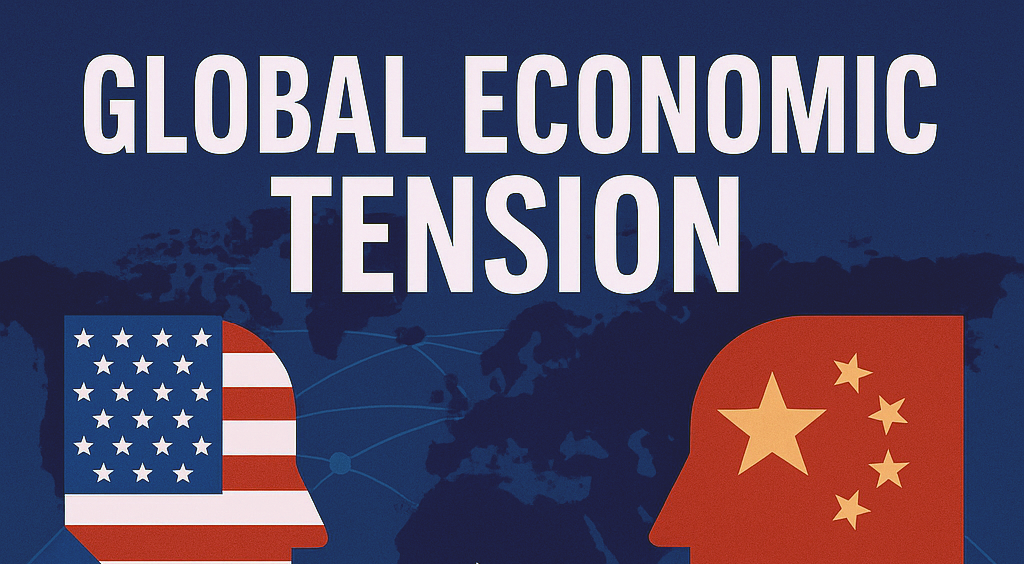
Recently, China hit a $1 trillion trade surplus despite the U.S. imposition of tariffs. Chinese exports to the U.S. are going down, with the rest of the world picking up the slack.
In a sense, this is good. Why? Because China is giving away real resources to the rest of the world in exchange for financial claims. Clearly, there is more to it.
Global trade in the present era is very beggar-thy-neighbor in that countries are fighting one another to run trade surpluses. Obviously, not every country can run a trade surplus; for every net exporter, there must be a net importer. The U.S. has been the biggest net importer in the world since the end of the Bretton Woods era, where the U.S. Dollar was floated and convertibility to gold stopped. This makes the U.S. rather special since it is the first country in the world to succeed in being the hegemon despite being a debtor.
Why? Because the U.S. is the sovereign issuer of the U.S. Dollar; it has a monopoly on its issuance, and it is not constrained in a financial sense. Before floating currencies, in the gold standard era, countries had to maintain exchange rate parities or gold convertibility by borrowing in currencies they could not issue. For countries with trade deficits, this limited their policy space to spend to maintain full employment. Naturally, this resulted in trade deficits between countries being low since countries would avoid excess borrowing by compressing imports. For example, the British Empire ran on current and capital surpluses against the rest of the world, extracting resources from colonies, denaturalizing the colonies, etc.; they were a net creditor, not a debtor.
This is the biggest reason why American current account deficits blew up after the end of Bretton Woods. It didn’t have to worry about convertibility anymore. The U.S. invested in Dollars abroad to offshore its domestic production. This created local unemployment and weakened trade unions who lost their wage-setting power. But the result was that countries like Japan, South Korea, China, etc., all got massive amounts of U.S. Dollars; they accumulated it. In exchange, the U.S. got real goods and services. This is why American current account deficits grew rapidly.
You might be wondering why the rest of the world is so willing to accumulate U.S. Dollars even now, despite the U.S. being a net debtor to the rest of the world. For smaller Third World countries, the answer is pretty clear: they need it to import essential goods and services like fuel and food. But there is more to this. Third World countries, just like their First World counterparts, are at present controlled by rentier and parasitic capital interests. These individuals like storing their wealth in U.S. Dollars; they like borrowing in U.S. Dollars. And to maintain their solvency against a currency mismatch, they like a stable exchange rate. This is the reason why we are seeing so much concern from the financial press about exchange rate depreciation; they do not care about exchange rate pass-through beyond effects on profits. They care more about the value of their wealth hoards, their international purchasing power. I discussed this in my previous blog.
Exporters are another reason why Third World countries like accumulating Dollars. Exporters do not care about national interests. Their interest is in turning money into more money to realize the profits they expect. When exporters have influence on government policy, they tend to favor policies that promote exports, even the exports that may not be in the country’s best interests. This is part of the reason why India has accumulated massive amounts of U.S. Dollars.
Going back to China, given that we are in a beggar-thy-neighbor environment, and Chinese exports are very competitive in money terms, and their want to have a trade surplus, the goods must go somewhere. This is why German industry is being undermined by Chinese imports. Because German industry is simply uncompetitive compared to Chinese imports. China may have higher productivity, lower wages, a favorable exchange rate, etc.
Given this situation, the best way for India to prevent the deindustrialization of the already small industrial sector it has, which will increase already bad unemployment, the only way is to go beyond neoliberal logic.
Export-led growth, i.e., the thinking that a country can grow simply by increasing exports, is a firmly neoliberal idea. As I said, given China’s dominance in exports, India’s exports must come at the expense of Chinese exports. Since India has low productivity, and because global demand is limited, the only way to increase exports is by outcompeting China (unlikely given the situation) or the rest of the world being willing to accept Indian goods. The rest of the world’s willingness comes from the respective countries’ aggregate demand. Given that they all are trying to increase exports by compressing demand, this will be low. Thus, India’s strategy to grow must involve going beyond neoliberalism.
India must focus on domestic demand. It can eliminate involuntary unemployment entirely by providing a universal employment guarantee. I have talked about this in several of my previous blogs. You can read more on it there. This alone will be a potent policy to increase aggregate demand. It will also accommodate any rise in unemployment arising from stress on the industrial sector.
Secondly, to prevent local industry from becoming uncompetitive, India must let the Rupee find its market value. The government must instead control the value of essential goods, particularly fuel, to reduce exchange rate depreciation. Certain luxury goods which provide no benefit to the country, like gold and silver for jewelry or as a store of wealth, can be tariffed heavily.
Lastly, India must increase the role of the public sector in the economy. It must set up state-owned enterprises capable of setting prices to compete with imports. This is a great tool which allows the country to not suffer from deindustrialization from imports.
It may be argued that price setting will cause these enterprises to run deficits. But that’s the point. Indian goods are uncompetitive only in money terms, not real resource terms. India has plenty of resources to maintain and increase its industrial capacity. By setting prices, it gets to keep its own output and employment and have foreign imports at the same time.
I do not believe much is going to change. I am only stating what should be done.
That’s all.