
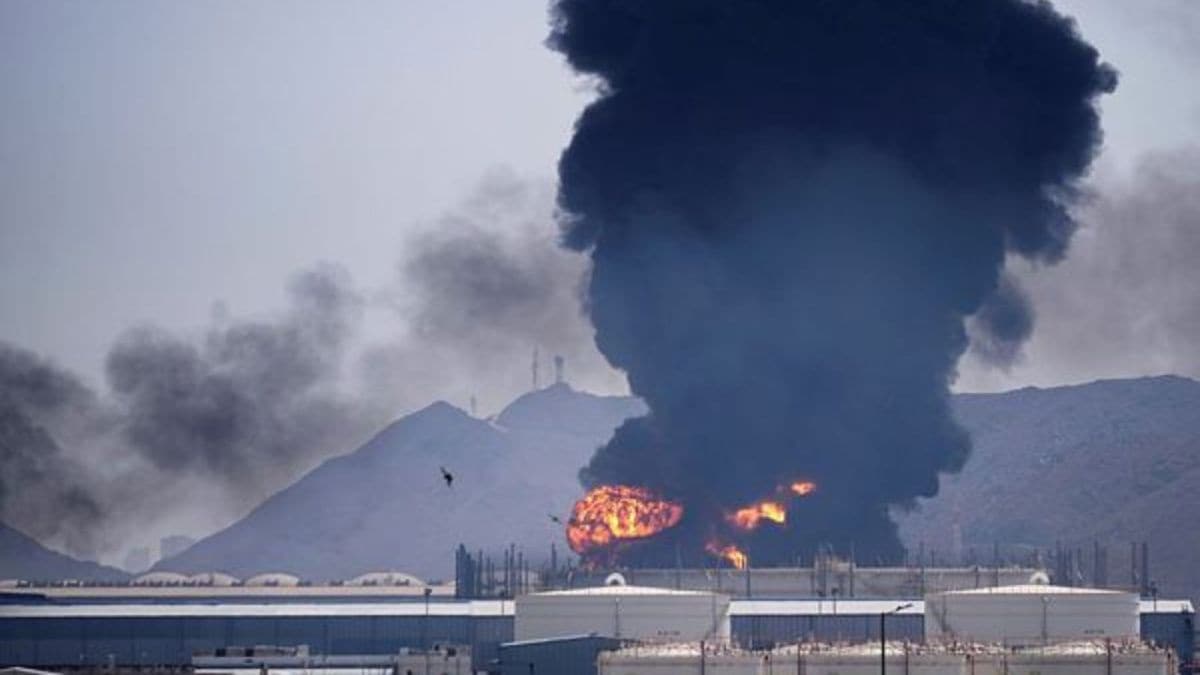
The world economy is facing a severe economic shock due to the U.S.-Israel war on Iran. In response, Iran has closed the Strait of Hormuz, and only a few ships pass through the strait now compared to over a hundred before the closure.
Also, Iranian airstrikes have destroyed oil refining capacity, which results in a rise in the price of and availability issues with crude oil derivatives like petrol, diesel, plastics, jet fuel, etc. There have been attacks on natural gas facilities as well, which results in a rise in the price of and availability issues of LPG, PNG, CNG, as well as helium, which is used in MRI machines for creating magnetic flux.
I want to discuss the macroeconomic impact on India due to this war.
Firstly, India cannot face a balance of payments crisis like what happened in 1991, in part due to the Gulf War. This is because, since the late 1990s, the Indian Rupee has been floating. Hence, the Indian Government is not obliged to maintain a fixed parity for the Indian Rupee. A balance of payments crisis can only happen when a country (either/both Government and/or non-Government sector) is unable to meet external obligations in foreign currency (the Indian Government can always make payments in Indian Rupees) or is forced to devalue or float its currency due to insufficient foreign currency reserves.
India has sufficient forex reserves to cover its foreign currency obligations, and on top of that, its foreign exchange markets are deep enough. This makes a balance of payments crisis highly unlikely.
Secondly, India will have no trouble making payments in Indian Rupees. India’s local financing will be perfectly fine, as long as the Central Government doesn’t constrain itself with self-imposed fiscal rules. A shock like this one will reduce the income of the non-Government sector, which must be countered by the sovereign Central Government with increased spending. It should refrain from raising taxes or cutting spending. In fact, a rise in discretionary spending may be required to cushion the impact.
All that said, I want to talk about binding constraints:
1. Real resource constraint: India is losing access to or has to pay a higher price to get resources like oil, helium, gas, etc. Logistical issues can make goods unavailable regardless of price. This will clearly be negative for output and employment. See the impact it has had on Indian restaurants, with people standing in line for cooking gas, etc.
2. Exchange rate depreciation: Shocks such as this one result in a flow of capital abroad, which manifests as a depreciation in the exchange rate as well as a reduction in financial asset prices. The Indian stock market has not been doing so well, at least in part due to this reason. This depreciating exchange rate reduces real purchasing power and has a negative impact on effective demand. In essence, the country gets fewer real resources from the world. The Government can counter the financial impact of the same by increasing spending and or cutting taxes, which will be good, but it cannot do much about the real impact, i.e. imports must go down.
3. Lower global demand: The external demand for Indian goods and services will decrease due to the shock. Firms abroad will downsize, and people will cut spending. This means the world is less able to buy Indian goods and services. The export sector employs millions of workers and allows India to import. A decline in the export sector will have a negative impact on the aforementioned exchange rate as well as employment. The employment issue can be stabilised with a universal job guarantee, as I have discussed in my previous blogs. The unfortunate reality is that no such universal guarantee exists in India at present, so unemployment will rise.
4. Lower remittances: Remittances are a relatively stable source of India’s balance of payments. However, given that a significant portion of Indians abroad work in West Asia, the war will have a negative impact on remittances, as they may lose jobs or are faced with higher costs or lower pay. For India, remittances have a double effect. One, obviously, is the balance of payments. The other is that remittances are a source of income for poor and less well-off households in India. A reduction in income will have a negative impact on output and employment for the economy as a whole. The Indian Government can counter the loss of income by increasing spending targeted towards the poor, but it cannot mitigate effects on the balance of payments. Exchange rate depreciation should at least somewhat counter the loss of income abroad, since Indians abroad send more dollars and Indians get more rupees, at least some sections of Indians, when the exchange rate depreciates.
5. Lower domestic demand: Due to these factors, rise in input prices, depreciation of the exchange rate, and the induced rise in local prices, there will be a decline in effective demand in the Indian economy, i.e. people may not have the purchasing power to buy what is being produced, which results in downsizing and reduced spending, income, and employment.
What is to be done about this? In my opinion, it is best to split this part into real, well mostly (such as import substitution), and financial (fiscal and monetary policy):
Financially:
1. The Government should cut, not raise, interest rates. This can promote investment to increase productivity and cut off wasteful interest payments which leak outside the spending cycle.
2. The Government should increase spending and cut taxes. The purpose of this is to counter lost income in the private sector so that people are able to pay down existing debts and maintain some consumption. Of course, given the supply shock, it will be wise to allow fuel prices to rise slowly so as to allow the private sector to adjust to the new reality.
3. The Government can use hundreds of billions of foreign exchange reserves it holds to purchase crude oil, gas, fertilizer, etc. Basic and essential inputs.
4. The Government should refrain from intervening in the foreign exchange market by drawing down reserves to cushion depreciation. Why? Because doing so promotes further outflows as people seek to exit the currency at subsidized rates. They will also import more unnecessarily. As mentioned previously, the focus should instead be on bypassing foreign exchange markets partly and importing inputs directly using foreign exchange reserves.
5. Implement a strong automatic stabilizer such as a Universal Job Guarantee (UJG). This ensures that all the people who lose jobs and hence income will have an alternative.
6. Since the wages provided by the UJG are only the minimum, the Government should implement an unemployment insurance policy for formal sector workers to ensure that those who are laid off are compensated for a few months.
Real:
1. This may be financial as well as real, but promote more induction cooking by subsidizing induction cooktops. Any rise in the use of induction cooktops will be positive for the economy since dependence on expensive natural gas is reduced. It is also better for the environment and indoor air quality.
2. Promote renewable energy by increasing Government spending and investment while avoiding private rent seeking.
3. Implement a rationing scheme for end consumers wherein the first cylinder or first few litres of gas are provided at subsidized rates. This will help the poor while also preventing black marketing and excess demand. For anyone with greater needs, fuel may be provided at market rates.
4. Implement better buffer stocks for oil and natural gas to stabilize supply. This requires investment in storage.
5. Make deals with alternate powers like Russia and Iran to import more oil.
These are a few suggestions I can think of. Of course, none of it will be implemented, so what will be the reality?
1. Multiple levels of passthrough of prices, from commodities themselves and the exchange rate.
2. Since firms are more powerful than workers in our country, profits will rise and real wages will fall.
3. A general fall in effective demand due to lower real wages, which results in higher unemployment and lower income for workers due to downsizing by firms.
4. A fall in financial asset prices like stocks and non-sovereign bonds. This has already been happening, as foreigners flee to the U.S.
5. Due to self-imposed fiscal constraints, the Government may cut spending instead of raising it as tax revenues decrease due to lower activity. Not a good policy, but likely the reality.
6. The RBI may keep interest rates the same or raise them to prevent depreciation of the exchange rate. This wastes Government spending on interest payments and increases the cost of investments to improve domestic capacity.
Overall, not looking good. While there are mitigation measures, they are unlikely to be implemented due to self-imposed fiscal constraints.
What should you do?
There is not much that can be done. Of course, if you work in the public sector, you are relatively insulated from job loss, and your salaries are indexed, at least partly, to the price level.
If you are in the private sector, I would suggest diversifying and buying foreign currency bonds, while using small amounts of disposable income to buy shares both at home and abroad. Lower asset prices allow you to buy more of them.
It is not looking good. No supply shock is good for the world economy. One can only hope for a ceasefire. But a ceasefire would only postpone future conflict between Iran and Israel or the U.S., since Israel really wants Iran gone.
That’s all.