
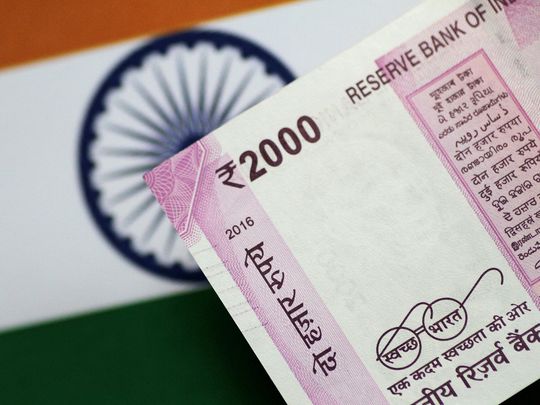
It is now pretty evident that the Reserve Bank of India is intervening in the currency markets to keep the Rupee stabilized amidst volatility due to actions by the central banks in U.S. and EU.1
On December 2023, the IMF reclassified India’s exchange rate regime as a ‘stabilized arrangement’ from ‘floating’.2 Regardless of whatever you might think of the IMF and its motivations behind this reclassification it can be seen that the Indian rupee has remained stable at around ₹80 for $1 since around October 2022. RBI did let the Rupee depreciate from ₹80 to ₹82 prior to that but it has by and large stayed there.

There are clear good reasons to do this. Exchange rate volatility increase exchange rate risk which discourages trade and investment, depreciation can also cause domestic inflation due to India’s reliance on imported essential goods like crude oil.
However there are nefarious reasons too. A stabilized exchange rate is a way for the capitalists especially to obtain more foreign exchange than they could’ve obtained at the ‘true’ market rate. By keeping the exchange rate in a specific range, by draining foreign reserves; the RBI is encouraging, subsidizing private sector capital outflows and speculation.
I’m aware that India’s capital account isn’t fully convertible for good reasons but India does have current account convertibility i.e. residents can send/receive money freely for trade, remittances etc.3 Thus, by keeping the exchange rate stabilized at an ‘overvalued’ rate, the RBI is encouraging imports & discouraging exports. To be sure, a developing country like ours should seek to obtain foreign technology. But, by intervening in exchange rates in this manner, the ‘cheap’ imported foreign goods is being made to compete against domestic goods. This discourages development of domestic industry and a situation where domestic goods are uncompetitive and displaced by foreign made goods. This goes against the ‘Atmanirbhar’ rhetoric of the Government.
This is why its difficult to have an open current account and a fixed (stabilized) exchange rate, it is always under pressure because of trade imbalances and speculation being encouraged.4
Is RBI intervening to benefit the big capitalists?
I don’t know the real motivations of the RBI intervening and stabilizing the exchange rates. If its done to reduce volatility they could’ve done so by controlling the amount of depreciation, preventing sharp and sudden declines instead of keeping the Rupee in a relatively narrow range.5 This would have increased trade competitiveness, discouraged imports of non-essential goods, discouraged capital outflows and kept inflation in check.
But they did not do that, they instead chose to keep the Rupee in a narrow range for nearly two years.
So that makes me think, are there other reasons behind RBI doing this?
It is well known that billions of dollars leave India in the form of capital flight and illicit financial flows. Some of it is not illegal, such as foreign portfolio investors selling their rupee-denominated Indian financial assets and obtaining foreign exchange. However, there are more nefarious types of capital flight, such as millionaires and billionaires sending their wealth abroad to evade taxes, or multinational corporations (MNCs) engaging in trade misinvoicing to launder money, illegally obtain ‘hard currencies’ like Dollar or Euro, take advantage of export subsidies, and evade taxes.6 7
This is a drain on all countries, including India. When exports are under-invoiced, the country is getting less than the actual value of goods. When imports are over-invoiced, the country is losing foreign exchange either through a drain on foreign reserves or in the foreign exchange markets which it could’ve used to improve itself.8
RBI interventions in foreign exchange markets is encouraging this kind of behavior, the criminals know that they can rely on the RBI to maintain the exchange rate by burning foreign reserves belonging to the public so that they get more Dollars. If the RBI allowed the exchange rate to depreciate naturally in response to capital flight, it would increase the cost of moving capital abroad. The depreciated rupee means those engaging in capital flight would get fewer dollars for their rupees, which could act as a deterrent.
And there is the fact that tax evasion increases inequality and lets the oligarchs control more resources than they already do. Sometimes, import over-invoicing is done to scam the Government as well, another wealth transfer from the Government to the capitalists in the non-Government sector.9
So, do I believe RBI is intervening to benefit capitalists? I’m not sure but it is at the very least an inadvertent effect of their actions.
Why import under-invoicing and export over-invoicing is different from import over-invoicing and export under-invoicing
When you import something from the U.S. worth $1000 and you pay ₹80,000 to the seller, it doesn’t as matter much what the amount you declare on Customs forms. The importing country loses $1000 in foreign exchange but also gets $1000 worth of goods. The only major negative of this is the customs evasion and loss of foreign exchange which could’ve been used differently.
There are other consequences too, such as the role of import duties in promoting domestic production (import substitution) and preventing displacement. If a country is already manufacturing a particular good, but one imports the same product exploiting an overvalued exchange rate and evading customs and duties designed to regulate it, it contributes to the displacement of domestic production, imports are a leakage of domestic demand as well. It also leads to the distortion of trade statistics, which the government relies on for economic planning.
As the UNCTAD report says:
However, not all trade misinvoicing generates capital flight. Specifically, capital flight occurs in the cases of export underinvoicing and import overinvoicing. In contrast, in the case of technical import underinvoicing (under-reporting of the value of imports) or pure import smuggling, there is no resulting capital outflow. Moreover, import underinvoicing or import smuggling does not constitute a total loss for the country as the goods enter into the country. However, the government loses customs duties on these imports, and the goods must be paid for in foreign exchange.
UNCTAD 2016
And export over-invoicing is done to launder money or take advantage of various export tax incentives provided by Governments to promote export-oriented activities.
What should the RBI do?
I believe that RBI should allow the Rupee to depreciate and find its market rate. This will stop the public foreign reserves being used to finance a small section of the private sector (i.e. capitalists, millionaires and billionaires).10
The Government must instead utilize its foreign reserves to ensure that prices of essential imported domestic goods like crude oil are kept in control. This could be done with discounted exchange rates for public sector oil and natural gas companies whereby a part of the foreign reserves is used for the benefit of the entire public instead of a select few.
Argentina example
The depreciation shouldn’t be rapid so as to ensure that the economy can adjust to it slowly. Recently, Argentina devalued official rate of Peso from ~ARS 360 = $1 to ~ARS 800 = $1 that is more than double, a 122% instant depreciation. Granted, this was the official rate and the black market rate of Peso was around ~ARS 1200 = $1.

Argentina had a multiple exchange rate system where different goods and services had different Government provided exchange rates. It was a bit of a mess because of the private sector trying to exploit the differentials. Regardless, the new heavily devalued Peso caused a massive pass-through inflation with Month-On-Month inflation rate reaching over 25% in December 2023.11
The situation was made much worse by the fact that the self-described ‘anarcho-capitalist’ President Milei also removed price controls and subsidies on essential goods in order to reduce fiscal deficits.12 Remember that the reason for Argentina’s woes is not the fiscal deficit but large foreign currency denominated debt.
I do not believe the devaluation itself was a bad idea since the overvalued multiple exchange rate system was draining foreign reserves, promoting capital flight, arbitrage and imports; it should’ve been done in a more controlled manner to ensure the economy could adjust. The removal of price controls and subsidies was just as responsible for the disaster as the rapid devaluation.
Back to India
The Argentine example shows us that combining private sector and easy capital/trade flows with a fixed (crawling peg) exchange rate is a terrible idea.
In our case, we have an open current account, partly open capital flows and a de-facto fixed exchange rate within an undefined band since late 2022.
This is why I believe that RBI/Indian Government must:
- Allow gradual depreciation of the Rupee by reducing its intervention
- Strengthen controls on Foreign Exchange and Illicit Financial Flows including especially trade mis-invoicing by large corporations
- Monitor and shut down black market foreign exchange trading. In recent times, Binance and other P2P crypto exchanges have been used to illegally obtain foreign exchange.
- Bring oil and natural gas sector under total public ownership
- Offer discounted exchange rates to public sector oil and natural gas companies with the rates adjusted slowly so the economy can adjust to changes in global oil prices without much pain.
- If the demand for petroleum is too still too high and draining foreign reserves quickly, enact rationing with special pricing to prioritize specific sectors (eg. Commercial transportation).
- Adjust the petrol/diesel taxes accordingly. Remember that petrol/diesel taxes are not for raising revenues but for managing demand.
Concluding with yet another Argentina example
Argentina’s economic issues are very different from India’s. Argentina has massive foreign currency denominated debt that is a major cause of their issues. However, there are parallels that can be drawn between the two countries.
In 2018, then President Mauricio Macri of Argentina, a neoliberal, obtained a $57 billion dollar-denominated loan from the IMF. Both the IMF and Macri knew that the foreign currency loan couldn’t be paid back but still, it came with austerity as is usually the case with IMF loans.
The loan allowed the country’s rich to convert their Argentine Pesos to US Dollars at a very favorable rate and drained the foreign reserves. The state ended up subsidizing the rich. Once they got their money out, the devaluation was sharp and painful for regular people.13 14
As the article says:
For debtor countries such as Argentina or other Latin American countries, the balance of payments has little to do with domestic prices, domestic wage rates or domestic cost of production. The balance-of payments – and hence, the exchange rate – is swamped by debt service.
That’s what the IMF does. That’s its business plan. It makes a loan to subsidize capital flight, emptying out the economy of cash, leading the currency to collapse, as it is recently collapsed. As soon as the $50 billion was expended, or wasted, in letting wealthy Argentinians take their pesos, convert them into dollars, move them offshore to the United States, to England, to the Dutch West Indies, and offshore banking centers. Then they let the currency collapse so that the IMF model, which it’s announced for the last 50 years, the model is if you can depreciate a currency what you’re really lowering is the price of labor.
Michael Hudson
That’s all.
- https://www.reuters.com/markets/currencies/constant-rbi-intervention-keep-rupee-tight-range-through-2024-2024-01-05/ ↩︎
- https://www.livemint.com/money/imf-reclassifies-india-s-exchange-rate-regime-to-stabilized-arrangement-from-floating-11702994795913.html ↩︎
- https://unctad.org/system/files/official-document/gdsmdpb20031p3_en.pdf ↩︎
- https://www.bot.or.th/en/our-roles/special-measures/Tom-Yum-Kung-lesson.html ↩︎
- https://en.wikipedia.org/wiki/Snake_in_the_tunnel ↩︎
- https://unctad.org/system/files/official-document/suc2016d2_en.pdf ↩︎
- https://economictimes.indiatimes.com/news/economy/foreign-trade/india-lost-usd-13-billion-to-trade-misinvoicing-report/articleshow/69674502.cms?from=mdr ↩︎
- https://www.adaniwatch.org/exclusive_documents_suggest_adani_companies_over_invoiced_power_equipment_siphoned_money_part_1 ↩︎
- https://www.ft.com/content/7451f2de-91fa-49f3-acb3-e83ab5c00eff ↩︎
- https://economictimes.indiatimes.com/nri/migrate/why-are-indias-richie-rich-choosing-dubai-to-migrate/articleshow/111145455.cms?from=mdr ↩︎
- https://tradingeconomics.com/argentina/inflation-rate-mom ↩︎
- https://www.aljazeera.com/news/2023/12/13/argentinas-far-right-president-starts-term-with-sharp-currency-devaluation ↩︎
- https://www.nakedcapitalism.com/2018/07/michael-hudson-argentina-gets-biggest-imf-loan-history.html ↩︎
- https://www.nakedcapitalism.com/2018/07/michael-hudson-argentinas-new-50-billion-imf-loan-designed-replay-2001-crisis.html ↩︎