
There has been much talk from mainstream media about the Indian GDP projected to grow at just 6.4% in 2025.
The Indian government also aims to reduce fiscal deficits to please foreign capitalists. Growth and such self-imposed caps on fiscal deficits often contradict each other. You can’t have GDP growth without spending, and if the private sector is unwilling to spend, only the sovereign can unconditionally spend, as it doesn’t have to worry about monetary profits.
When government spending is insufficient due to self-imposed caps on fiscal deficits, along with a combination of wrong priorities (such as focusing too much on infrastructure investments), a problem arises. A government sector deficit is equal to a non-government surplus. However, such accounting facts may obscure the reality that the ‘non-government’ sector includes everything from the external sector and private corporations to people earning Rs. 5,000 a month.
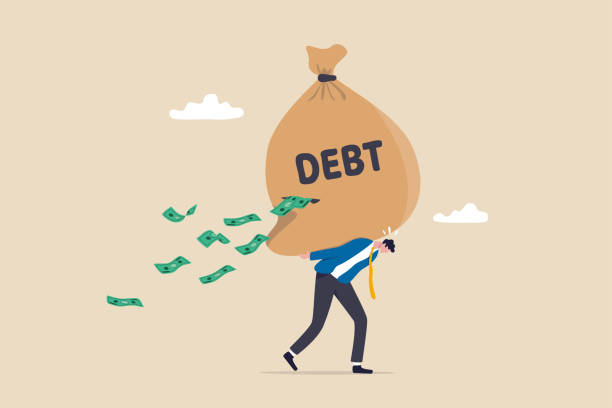
The rise of predatory lending among the poor in recent years indicates that parts of the non-government sector are becoming highly indebted.1 In rural India, food accounts for 48.43% of the consumer spending.2 The rising indebtedness is clearly not because rural Indians are purchasing luxury goods or ‘living beyond their means.’
In such a situation, only the central government can inject financial assets and hence, purchasing power into the hands of the people. Small cash transfers, while better than nothing, are insufficient and many times come from state government funds, meaning cutbacks in other areas. (See my blog on why Indian state governments are very fiscally constrained).3
The Indian central government, as the sovereign issuer of the rupee, is only constrained by real resources, no matter what mainstream economists say. It must increase spending without cutting back on other areas. This will, in the absence of increased taxation, result in a rise in the fiscal deficit. This is fine—it will lead to short-term depreciation in the exchange rate. The government must ensure that the prices of imported essential goods like fuel and fertilizer are kept stable through all available tools, such as using foreign exchange reserves, foreign exchange controls, and price controls.
Neoliberal commentators criticize certain government schemes, like ‘Ladki Bahin’s Yojana,’ for ‘fiscal profligacy.’ This is wrong. At the aggregate level, such schemes add financial assets to the non-government sector. The ‘exchequer’ can’t run out of rupees.
At the aggregate level, government spending increases demand, which drives output. The most ‘wasteful’ spending is that which leaks outside the spending cycle. This includes spending that is very import-intensive, such as capital-intensive road building where machinery is imported, or spending that doesn’t have significant multiplier effect. For example, giving the richest man in India Rs. 100 crore increases his wealth but isn’t going to be spent anywhere.
Cash transfers are not wasteful. Giving a poor person Rs. 5,000, even as a one-time payment, results in them spending almost all of it or paying down their debts. Either way, it increases their capacity to spend on real goods and services. The poor also consume goods that are locally produced, so leakage is minimal. Criticisms of such cash transfers from the standpoint of ‘fiscal prudence’ are almost always invalid in a country like India.
Valid criticisms of cash transfers include the fact that they can be taken away anytime the government feels like it, which makes beneficiaries feel like ‘freeloaders’ who aren’t contributing to society. Therefore, I believe a basic income should be established as a right for people who are unable to work.
Those who are able to work must be provided with work by the government through a Universal Job Guarantee scheme, which I’ve discussed previously.4
My point is that employment is a right. If a person isn’t able to work, they must be provided with a basic income as a right. It shouldn’t be treated as a carrot to get voters to vote for your party. Only the central government can ensure that funding for schemes is always available, as it is the sovereign.
Increasing household debt will be a further drag on growth because household debt can only grow so much before people are unable to repay and/or banks refuse to lend more. Once lending slows down, so will private consumption and investment, and along with it, the much-touted GDP growth will slow as well.
Only the government, the central government, can reduce household debt through increased spending. Unfortunately, under the neoliberal regime, self-imposed caps on fiscal deficits prevent the government from doing so, even if it wanted to. These caps, however, are self-imposed, and as I said previously, the sovereign has an unlimited capacity to issue rupees and is only constrained by real resources.
I do not care much about GDP. Indian GDP growth figures reflect only the organized sector, while growth in the unorganized sector is merely imputed. I care about real things, and the reality is that people, especially the bottom 80%, are suffering financially due to rising unemployment, private debt, and primarily supply-side inflation that is eroding real incomes.
That’s all
- https://thewire.in/women/microfinance-data-capture-tamil-nadus-debt-distress ↩︎
- https://mospi.gov.in/sites/default/files/publication_reports/HCES%20FactSheet%202023-24.pdf ↩︎
- https://sidharthpsiva.in/index.php/2024/07/13/not-enough-fiscal-space-for-schemes-by-indian-state-governments/ ↩︎
- https://sidharthpsiva.in/index.php/2024/06/29/india-needs-a-universal-job-guarantee-with-wages-fixed-to-the-minimum-wage/ ↩︎