
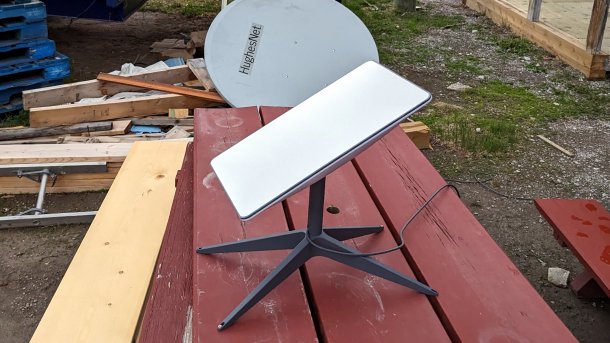
Recently, two of the largest telecom providers in India signed a deal with Elon Musk’s Starlink to provide satellite internet services in India. 1
There are several reasons I believe it is not a wise idea to let Starlink into India.
Starlink is effectively a monopoly for now. There are no major satellite internet providers offering decently fast, low-latency satellite internet. All the major satellite providers that existed before Starlink use GEO satellites, which result in high latency and low speeds but provide wide coverage with fewer satellites. Starlink, on the other hand, has thousands of LEO satellites, allowing for low-latency and higher-speed internet.2
However, I will be talking mainly about the political and economic side of things. The monopoly status of Starlink means that if their services are allowed to proliferate widely, they could threaten to shut off access to Indian users. In fact, Elon Musk has already made such threats against Ukraine:
Musk said on X that Ukraine’s “entire front line” would collapse if he turned the system off. Radoslaw Sikorski responded, saying his country paid for its use in Ukraine and a threat to shut it down would result in a search for another network.3
And the replacement (if one exists in the future) will be very costly since all the satellite dishes will be turned into bricks. The economic cost of such an outage would be extremely damaging as well.
There is also the concern of Starlink satellites belonging to a foreign company. This gives them complete access to all internet traffic going through it. While TLS encryption prevents them from reading or modifying HTTPS pages, it still remains a huge risk due to data mining using deep packet inspection. Also, the U.S. government will easily be able to obtain data logs.
Another issue is pricing. Even in Global South countries like Brazil, Starlink charges quite a high fee, $31.7 for personal users and $77 for business users.4 In neighboring Bhutan, it costs $35 (3,000 BTN) per month. It is evident that Starlink is pricing in dollar terms, even when prices are stated in local currency. So, if the Rupee (since the Ngultrum is pegged to the Indian Rupee) were to depreciate from ₹100 = $1 to ₹200 = $1, Starlink would double the prices in Rupees.
This is a big problem for Global South countries because it essentially ties pricing to the exchange rate. Will Airtel or Jio price it similarly, adjusting prices according to the depreciation of the Rupee?
It is very likely that they will, since they are essentially acting as intermediaries. They will have to pay whatever amount Starlink demands. Starlink will likely demand U.S. dollars, meaning Airtel and Jio will have to obtain them from foreign exchange markets. This, in turn, puts downward pressure on the Rupee, which can lead to pass-through inflation. If the RBI is targeting a certain exchange rate, it will have to draw down its foreign exchange reserves.
And that brings me to the final point; who can afford this? Is satellite internet really suitable for India? India is a very unequal country; as I said in my last blog, its middle class is really just the top 10%. Who will be willing to pay $200 for the Starlink Mini kit and $35 a month for the service?
Recently, a report by Blume5 showed that there are three Indias: India1, comprising 140 million people; India2, comprising 300 million people; and India3, comprising 1 billion people. Only a small portion of India1 will be able to afford Starlink. The question is, why would they?
Most people in India1 live in large cities, where wired and wireless connectivity are both very developed. You can get Airtel fiber connection for ₹499 a month ($6), and it’s unlikely to be as coupled with exchange rate as Starlink. Or ₹399 for JioFiber. One might complain that these are low speeds, 40 and 30Mbps respectively. However, Starlink only claims “download speeds between 25 and 220 Mbps, with a majority of users experiencing speeds over 100 Mbps”. With fiber on top ISPs, you are guaranteed to hit such speeds all the time for Indian servers at least. And on top of that, latency will be much lower with a wired connection.
There are roughly 39.4 million wired internet subscribers in India, most of them belonging to India1. There is no reason for them to spend $200+$35/month on Starlink.
Most people in India (comprising India1, India2 and India3) use wireless 5G/LTE, lower level plans cost ₹300 a month. This gives them unlimited calls, texts and 1GB/day. Not a lot but you can watch some videos on SD no problem. Again, why would these users spend $200 + $35/month on Starlink? They could just pay more for a higher 5G/LTE plan, ₹360 gives you 50GB on your existing pack.
But they might want unlimited, even then there is ‘Fixed Wireless Access’ internet i.e. AirFiber from both Jio and Airtel which use 5G/LTE to provide 30Mbps ‘unlimited’ for ₹599 (in reality it’s 1TB, still, most people won’t hit that).
All this means that market for expensive satellite internet will be quite small in India. India isn’t the West, most people here don’t have adequate purchasing power to afford such services, and that applies especially to remote regions.
I believe that it would be far more beneficial for state-owned telecom companies like BSNL and RailTel to provide internet connectivity to all the remote regions. Satellite internet should be reserved for most extreme environments where running fiber isn’t feasible, though even in such cases, microwave links (for example) can be used instead to provide long term connectivity.
It would make India less reliant on foreign companies and would be far less foreign currency intensive.
That’s all.
- https://www.channelnewsasia.com/business/india-watchdog-plans-limit-satellite-permits-five-years-defying-musks-starlink-4997851 ↩︎
- https://www.bbc.com/news/articles/cy4dnr8zemgo ↩︎
- https://www.bbc.com/news/articles/cy87vg38dnpo. ↩︎
- https://www.starlink.com/br/service-plans/personal ↩︎
- https://docsend.com/view/pyxuqunkm9ejw38q# ↩︎