
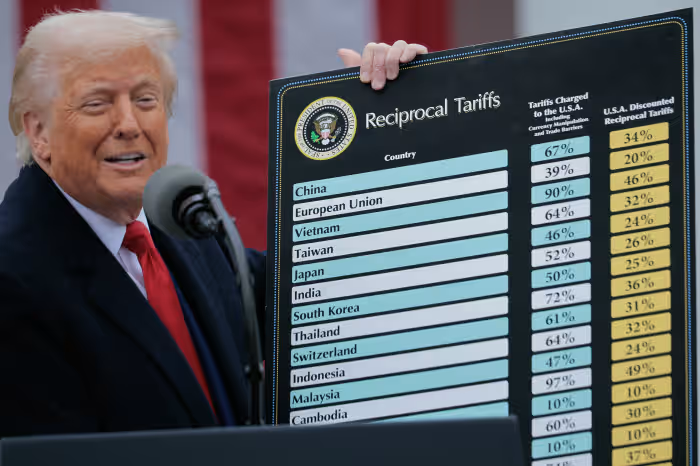
The Trump administration’s 50% tariffs on India have gone into effect today, 27th August 2025. In this blog I will talk about the importance of exports as well as what India can do to mitigate the adverse effects of Trump’s tariffs. I am well aware that, due to political realities, none of what I suggest will be implemented, but it is important to understand that what I am suggesting is not utopian and is perfectly possible economically.
Exports
What are exports? Exports are goods and services that a country produces and then sells to buyers in other countries. But what are the effects of exports on the economy? Why do countries give away their resources for electronic entries (e.g., U.S. dollars)? Because exports support employment, income, and output in the exporting country. It must be remembered that exports increase the profits of capitalists as well.
Exports are a component of GDP, which is Consumption + Investment + Government Spending + (Exports – Imports). India is a net importer; it imports more than it exports, financed by capital inflows from abroad. Trade deficits drain GDP but help the country obtain real resources from abroad.
However, if you look at individual countries, India runs a significant trade surplus with the U.S. This, combined with capital inflows from abroad, finances India’s trade deficit with China and oil-exporting nations, including Russia. So, despite all the claims that India’s Russian oil imports reflect its sovereignty, it is ironically at least partly because of the U.S. that it is able to import from Russia, China, etc.
Will tariff shock cause a balance of payments crisis?
No. India has a floating currency with low sovereign debt denominated in foreign currencies, so it cannot face a balance of payments crisis like in 1991, when it had a quasi-fixed exchange rate and had accumulated significant foreign currency debt. Any shock caused by tariffs will show up as a drawdown of foreign exchange reserves by the RBI in the short run and as depreciation of the exchange rate in the medium to long term.
Exchange rate depreciation has two sides. On one hand, it will increase the cost of imports, which is especially important for essential goods. Exchange rate passthrough may cause a one-off rise in inflation, but it will not lead to an inflationary spiral since wage and salary indexation is rare outside the public sector (through Dearness Allowance) in India. This was demonstrated during the 2013 Taper Tantrum, when exchange rate depreciation resulted in only a temporary rise in inflation. On the other hand, depreciation will make exports cheaper and may partly offset the loss of competitiveness caused by tariffs. Exactly how much of the competitiveness lost from higher import costs is regained through cheaper exports is difficult to predict.
But no, India will not face a balance of payments crisis like in 1991. The rupee will likely see faster depreciation in the medium to long run.
Full Sovereignty approach
India, while being a developing country, is in a much more privileged position than smaller developing countries. It has its own floating exchange rate and non-convertible currency, the Rupee. It is in a position to not ‘make a deal’ with the U.S. and to follow its own independent trade policy.
The current 50% tariffs against India are clearly a coercive tool by the U.S. to open up India’s markets to American exports and undermine local production and competitiveness, particularly in the agricultural sector.
And while it is true that oligarchs benefited the most from Russian oil arbitrage, why should the U.S. decide who India trades with? Of course not. Russia is not a country sanctioned by the U.N.; these sanctions are unilateral.
What is to be done?
Here are some of my policy prescriptions:
- Implement a universal, unconditional job guarantee
As I said before, exports support the exporting country’s income, output, and employment. By implementing a job guarantee, India can compensate for the income and employment lost due to reduced exports. It is the perfect time to implement such a policy: provide a ₹18,000 per month salary to every Indian who wants a job, unconditionally. As long as they work the requisite hours, say 40 hours a week, they receive the salary.
This would also force the private sector to pay slightly above the floor wage to retain its workers, and the higher wages would in turn result in greater sales. So, beyond the aggregate demand increase generated by the policy itself, it would also have positive secondary effects as well.
It must be remembered that Profits = Capitalist Investment + Government Deficit – Worker Savings (in a closed economy). By forcing capitalists to increase their investments (i.e., wages), profits also rise. This is something mainstream economists tend to ignore.
To prevent inflationary spiral, any indexation of this wage must be handled carefully. However, if implemented, this policy would at worst cause only a one-off adjustment in prices.
- Reform GST and make it universal
In my previous blog I mentioned that while GST reforms are good, it must not be ‘paid for’ by spending cuts elsewhere. I want to expand this point further; India should make GST universal. Currently, there are thresholds, for example, only businesses whose annual turnover exceeds ₹40 lakh in goods have to register for GST mandatorily.
While I understand that such a policy is meant to reduce the burden on small businesses, it also means that the Government loses out on a significant lever to control aggregate demand. The informal and small business sector in our country is quite large. They desire Indian Rupees, the state currency, but are not taxed properly by the state.
It must be remembered that the Indian Government spends first and taxes back some of what it spends. In developing countries with large informal sectors this is a problem. The Indian Government is able to spend Rupees freely, but it cannot tax them back to create base demand for currency and control aggregate demand.
By removing the registration thresholds, the Indian Government gains a huge lever to manage aggregate demand. To ensure compliance for small businesses, the tax rate can be modest, for example, 5%. The Government can also provide ‘carrots’ in the form of cheaper credit from banks, free Point-of-Sale machines, as well as less complicated returns for low turnover businesses.
The point of removing the threshold is not to generate revenue but to bring more businesses into the tax net. A ‘light touch’ tax will do just fine. Of course, this will require more spending from the Government on enforcement of the aforementioned taxes.
GST must be reduced for both small and big businesses, particularly on ‘non-sin’ goods. The Government must remember the purpose of GST is not to raise revenue; the sovereign does not need revenue; it creates revenue by spending first. The purpose of tax is to control aggregate demand, create demand for money (since most people desire consumption), and to reduce consumption of sin goods (such as alcohol).
- Expand the Public Sector
India’s public sector has been neglected over the last couple of decades due to a neoliberal mindset. It is time to invest in public sector enterprises. The state can do all the things the private sector can, just as well, with proper planning. India must set up State Owned Enterprises for various purposes, such as manufacturing essential goods, as well as in sectors where the private sector is unwilling to invest properly, such as chipmaking. Thinking that the private sector can be ‘nudged’ to invest via supply-side measures is naïve, to say the very least. Subsidizing the private sector to get them to invest is simply more expensive in money terms; they want their own profit margins, and they will pay their workers the least they can get away with.
India needs high-quality, well-paying employment. While the aforementioned Job Guarantee is a start, it should be seen as a last resort, only to be taken when there is simply no well-paying job in the ‘proper’ private and public sector.
Notes:
- All of the policies mentioned must not be ‘paid for’ by cuts to spending by the Government.
- If there are any tax cuts, the states must be compensated appropriately so that there is a net injection of wealth to the private sector.
- If there are any spending increases, they must not be paid for by taxes on the poor by way of GST and other regressive taxes. Taxing higher income earners is fine, but it must once again be remembered that taxes do not fund spending for the sovereign. Tax the high-income earners to reduce inequality or to reduce demand if needed, not to ‘pay for’ things.
- Get rid of the ‘sound finance’ mindset. Finance must be functional; it must serve a purpose. There should not be any arbitrary self-imposed limits on fiscal deficits or Rupee-denominated Government ‘debt’.
- None of these policies run into any balance of payments constraints in a floating exchange rate regime. Any adjustment is borne automatically by depreciation of the exchange rate. This is fine; a weaker Rupee is worth it over neoliberal stagnation.
- If the depreciation is too high or too fast, trade and capital controls can be tightened. However, futile market intervention by way of managing exchange rates must be avoided.
On trying to substitute exports
There has been much talk about how India has been getting closer to Russia and China to counter the U.S. But none of the articles mention exactly how this may work. Russia and China are both net exporters, their policies are built around trying to maintain a trade surplus. India’s exports will eat into their trade surpluses. That is assuming they want Indian goods and the people and businesses there have the purchasing power to buy Indian goods in a way that perfectly counters American exports.
Obviously, Chinese tastes and American tastes for goods and services are different. You cannot substitute existing exports easily. Even in the long term, there is no reason to believe that there is enough demand in China and Russia to purchase what India has to offer.
The U.S. plays (not sure how long it will continue) a significant role as the only large country willing to absorb the exports of other countries. It is the ‘goods and services gobbler’; it takes away real resources from other countries and gives back paper and electronic entries created by itself, i.e. U.S. dollars.
The era of ‘export-led growth’ is over. Some countries succeeded somewhat with it, like South Korea, Taiwan, and Japan. But the only large country with large labor reserves to succeed in ‘export-led growth’ was China, and it did so with massive state-led investments, not through the neoliberal textbook version of an ‘economic miracle’. No country can pursue ‘export-led growth’ at present. Global aggregate demand has been low since the 2008 Financial Crisis. There is no alternative to increasing domestic demand, especially in the Trump era.
Conclusion
A radical shift away from neoliberal economic policies is required for India to succeed as a nation. Trump’s tariffs are a good reminder for India that it cannot rely on external demand to sustain its growth. India has a floating currency, low sovereign debt denominated in foreign currency, and sufficient monetary sovereignty to chart its own course by increasing domestic demand.
Short-term depreciation of the rupee and a possible one-off rise in inflation are acceptable costs to achieve sovereignty and to avoid subordinating our economic policy to the U.S.
India must urgently use the tools at its disposal to implement policies that secure and substitute income and employment losses due to tariffs. It must enlarge the public sector and realize the true purpose of taxes. None of these policies are unfeasible. There will be costs, but they are manageable.
The era of export-led growth is over. Rising protectionism, not just in the U.S. but elsewhere, means India’s economic future rests on increasing domestic demand through policies that serve the workers. India must understand the tools it has and what it is capable of.
That’s all.